systems
Four systems, each with a real figure and a sourced result:
- CorBin-FL — differentially private federated learning, one bit per weight.
- Agentic-SysID — a multi-agent pipeline that identifies control-ready models under an experiment budget.
- Game Analyst — adversarial multi-agent debate for NBA/MLB game analysis, graded against real outcomes.
- DDIM Time Series — treating tomorrow's price movement as an image-inpainting problem.
SYS.0
CorBin-FL
Differentially private federated learning, one bit per weight
- Problem
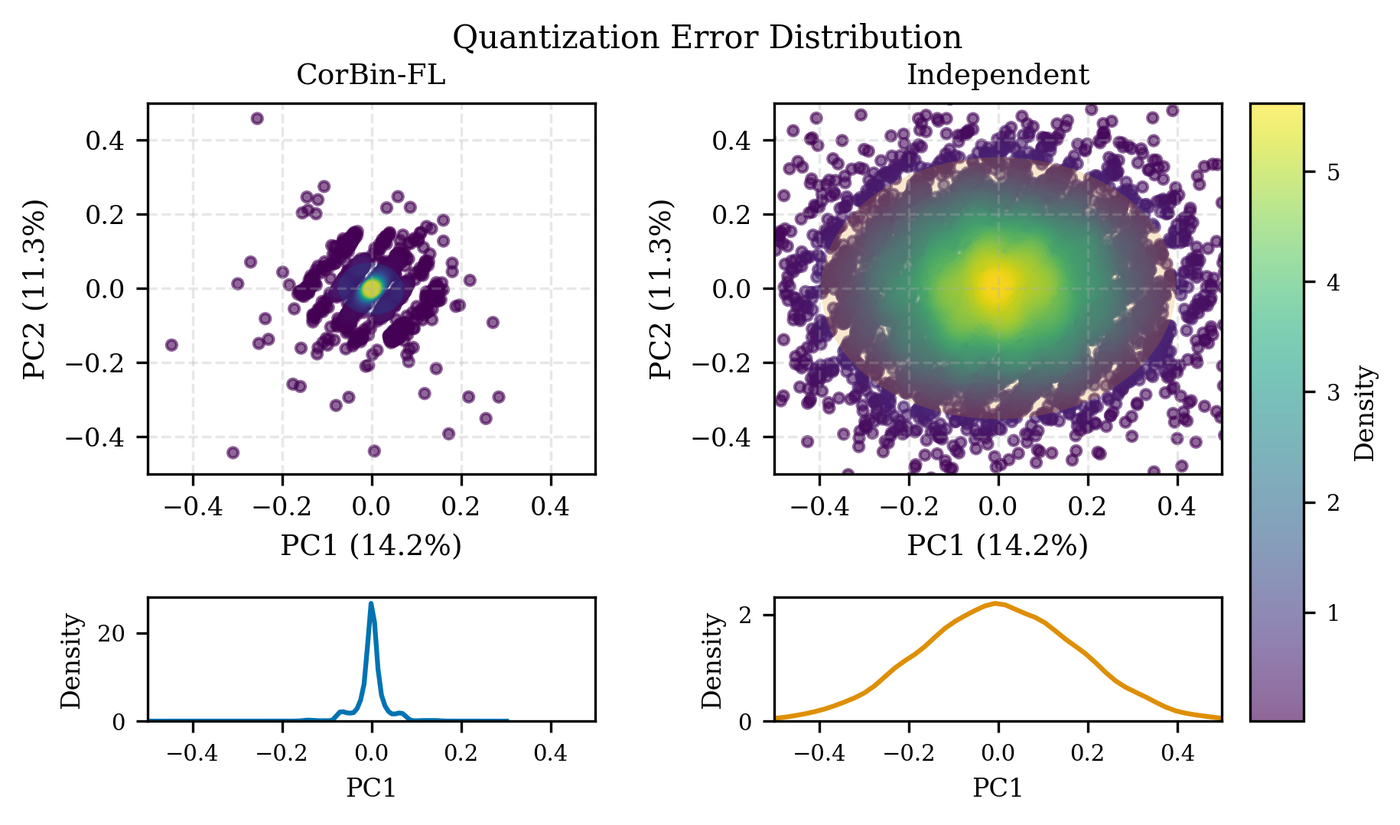
- Local differential privacy for federated learning usually means every client adds noise to its update independently. That noise doesn't cancel when the server averages updates across clients, so accuracy drops sharply at the privacy budgets (small ε) that matter in practice.
- Approach
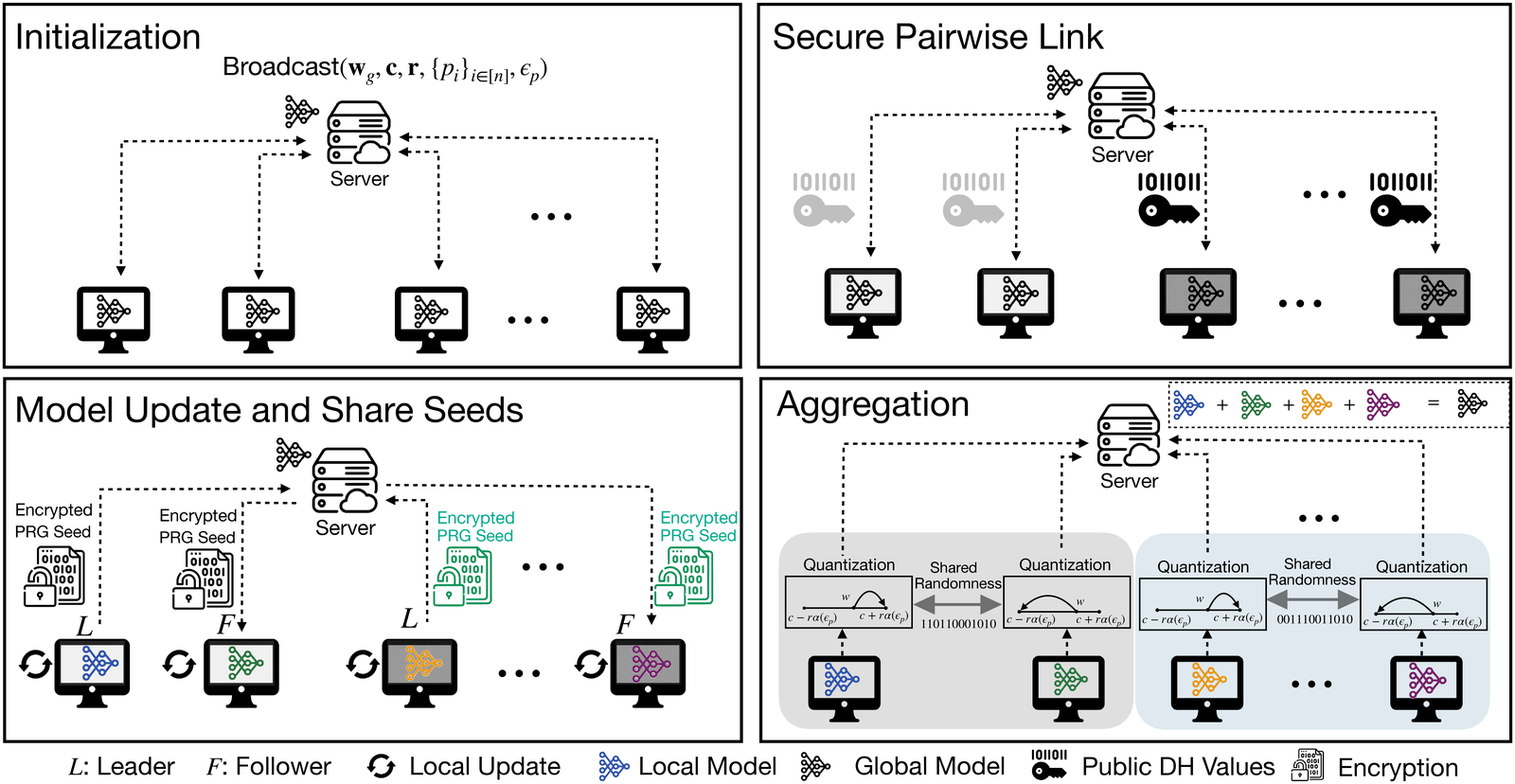
- CorBin-FL quantizes each client's update to a single bit per model weight, but draws the quantization noise from a shared source of randomness across clients instead of independent per-client noise. Each client still keeps its individual ε-LDP guarantee, but the noise is now negatively correlated, so it cancels out at the server instead of piling up.
- Result
- On CIFAR-10 at ε = 1 (50 clients, 100 rounds, ResNet18), CorBin-FL reaches 59.51% ± 0.24 test accuracy versus 44.23% ± 0.29 for the strongest 1-bit LDP baseline (LDPFL) — a 15-point gap at the same privacy budget and same communication cost. On FEMNIST at ε = 1, CorBin-FL reaches 82.82% ± 0.70 versus 80.75% ± 0.04 for the strongest baseline (Laplace).
1-bit-per-coordinate LDP baselines CorBin-FL is compared against
| Method | Privacy | Bits/coord | Reference |
|---|---|---|---|
| LDP-FL | ε-LDP | 1 | Sun et al. 2020 |
| I-MVU | ε-LDP | 1 / 2 / 4 | Guo et al., ICML 2023 |
| PBM-PLDP | ε-PLDP | 1 / 2 | Privatized Binomial Mechanism |
| RQM | ε-LDP | 1 / 2 | Youn et al. 2023 |
| CorQuant | None | 1 | Suresh et al. 2022 |
| SignSGD | None | 1 | Bernstein et al. 2019 |
| FedAvg | None | 32 | McMahan et al. 2016 |
| Gaussian LDP | ε-LDP | 32 | Balle & Wang 2018 |
| Gaussian CDP | ε-CDP | 32 | — |
| Laplace LDP | ε-LDP | 32 | Dwork 2006 |
SYS.0
Agentic-SysID
A multi-agent pipeline that identifies control-ready models under an experiment budget
- Problem
- Turning a physical plant into a control-ready model normally takes a control engineer manually designing experiments, fitting parameters, and validating the result by hand — and every experiment run against a real plant costs time and money, so the process can't just throw data at the problem.
- Approach
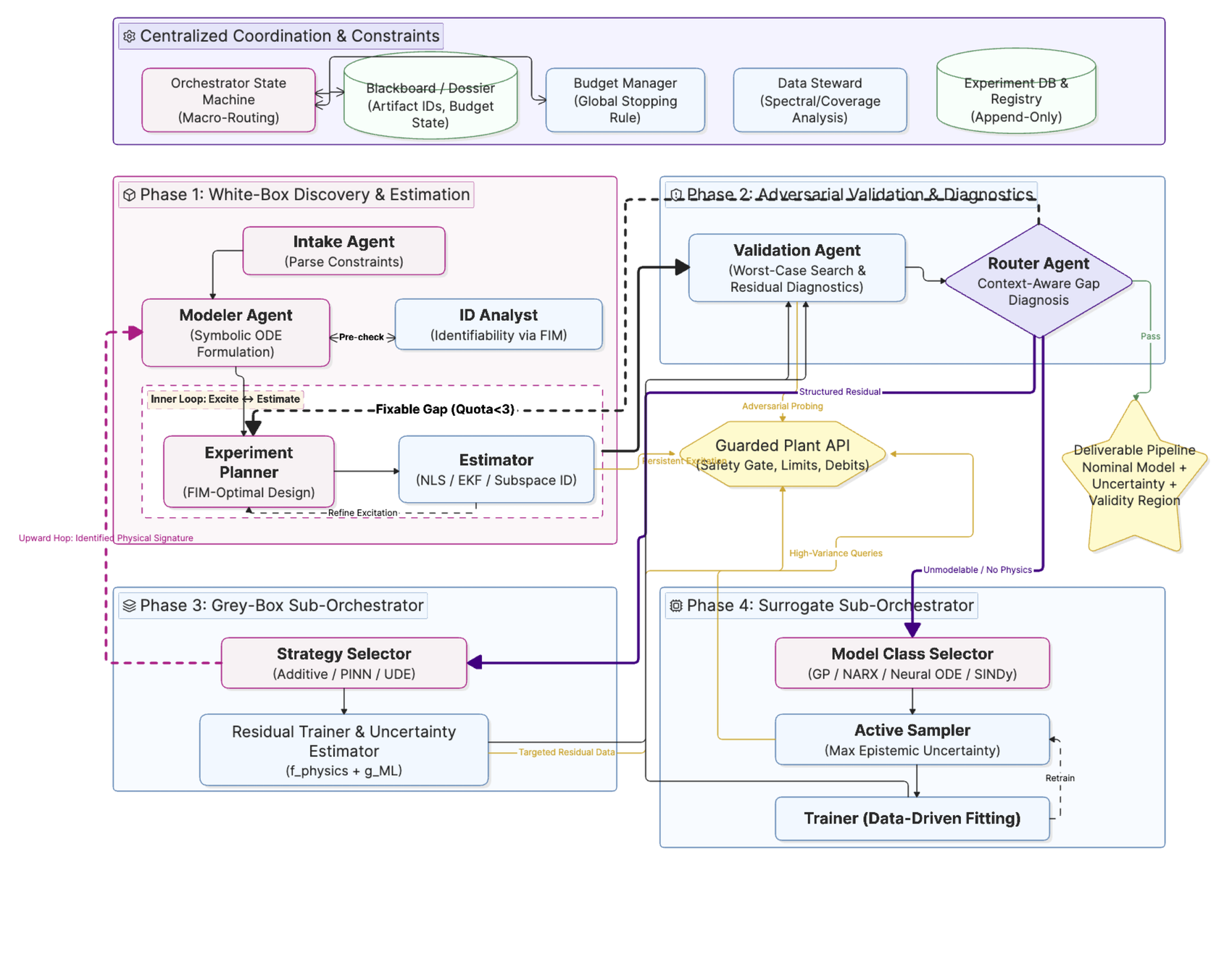
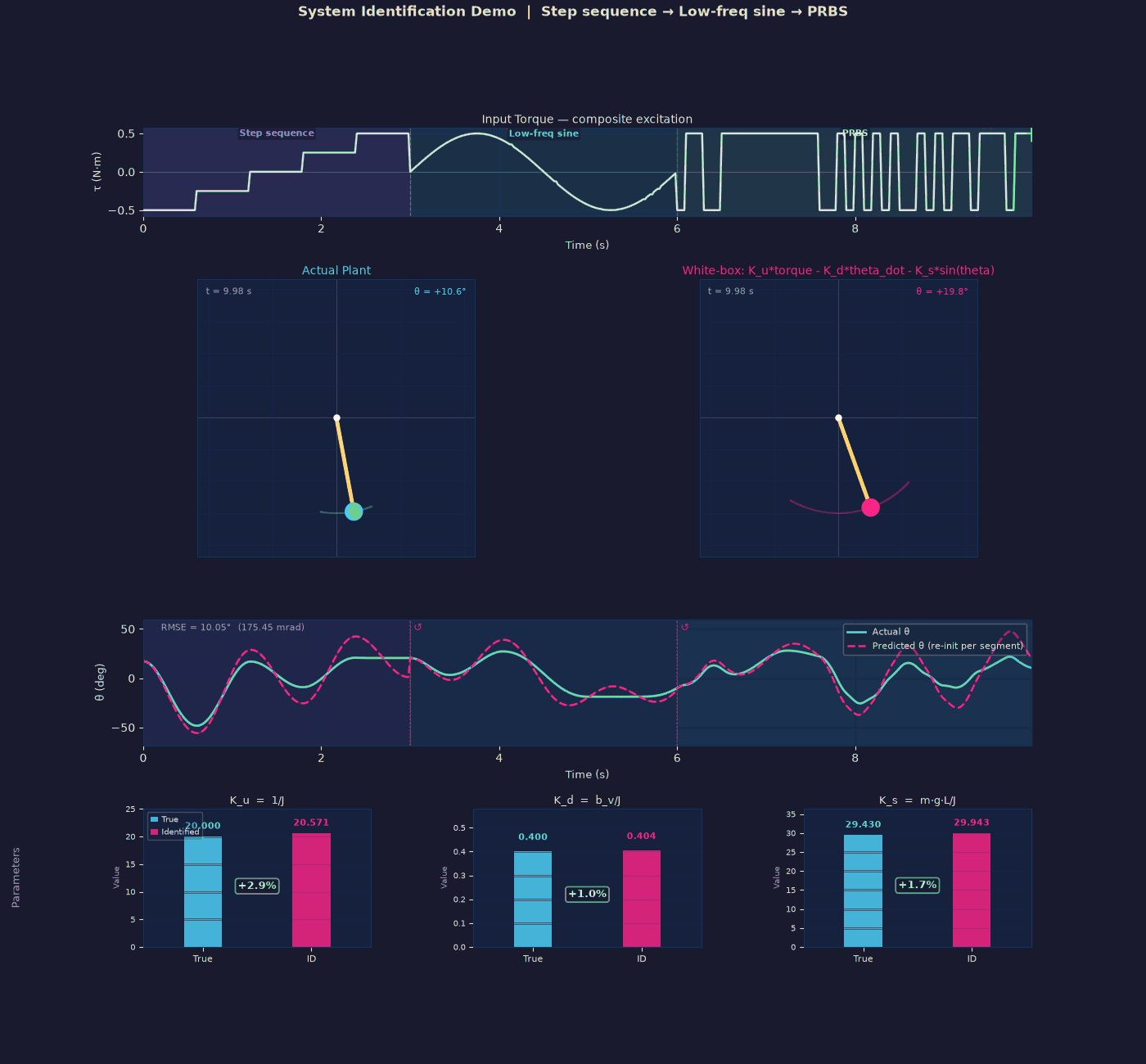
- Agentic-SysID automates that workflow with a physics-first fidelity ladder of specialized agents. An Intake agent parses the plant description; a Modeler agent proposes the ODE structure and checks identifiability; an Estimator agent runs an excite-then-estimate loop to fit parameters; a Validation agent probes the fitted model adversarially. Only if validation finds the white-box model doesn't hold does the pipeline escalate — to a grey-box model (physics backbone plus a learned correction term) or, if the plant isn't modelable at all, to a black-box surrogate (GP / NARX / Neural ODE / SINDy). Every experiment is routed through a budgeted, safety-gated Plant API, so no agent can overspend or bypass the safety limits.
- Result
- On the built-in pendulum benchmark, under composite step / low-frequency-sine / PRBS excitation, the pipeline's white-box model tracks the actual plant to 10.05° RMSE (175 mrad) and identifies all three physical parameters within 1–3% of their true, hidden values (K_u: 20.000 → 20.571, +2.9%; K_d: 0.400 → 0.404, +1.0%; K_s: 29.430 → 29.943, +1.7%). Experiments-per-run and fidelity-ladder descent rate across a broader set of plants aren't tracked yet — clone it and point it at your own plant to find out.
SYS.0
Game Analyst
Adversarial multi-agent debate for NBA/MLB game analysis, graded against real outcomes
- Problem
- A single LLM asked to predict a game's outcome tends to anchor on whatever narrative it reaches for first, with no mechanism to stress-test that call or check it against what actually happened.
- Approach
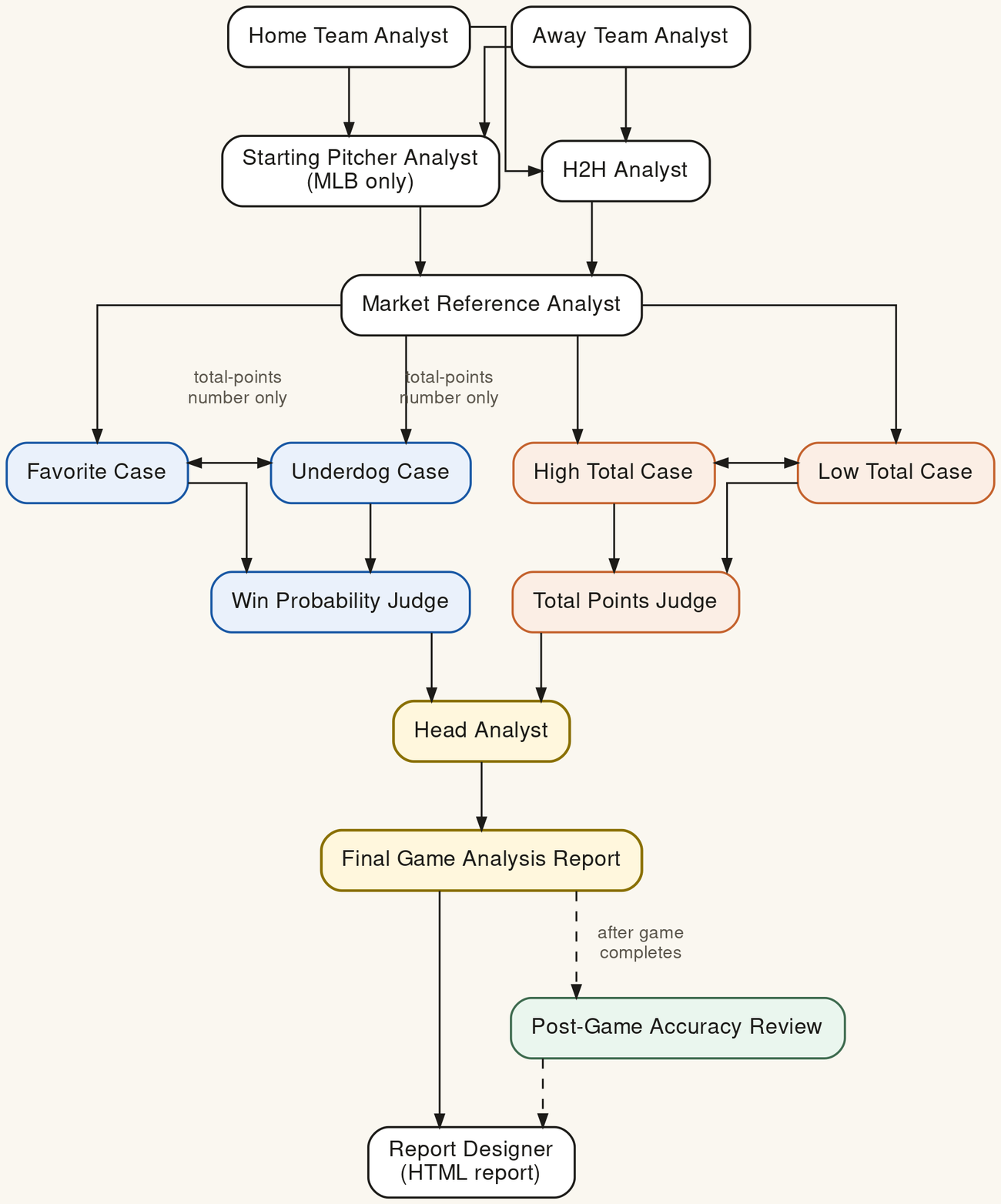
- Game Analyst runs the question through two parallel adversarial debates — a Win Probability debate (Favorite Case vs. Underdog Case, argued purely from team stats, form, and head-to-head history, with no market odds involved) and a Total Points debate (High Total Case vs. Low Total Case, using the market's total-points number as one input among several) — each converging through a dedicated judge. A Head Analyst cross-validates both judges' reasoning for consistency and writes the final report. Every analysis persists to SQLite and renders to an HTML report; once a game completes, a post-game accuracy review compares the prediction to the real result and writes a lesson per agent role into a ChromaDB memory store, so later analyses of similar situations draw on what past predictions got right or wrong.
- Result
- The system is built to grade itself — every analysis persists to SQLite, and a post-game review compares each prediction to the actual final score once the game completes (see `database/schema.sql`). One real recorded run is up on the Demos page — Royals @ Tigers, MLB, predicted Detroit at 63%, the Royals won 3–2 — but one game isn't a track record. No accuracy number to report until more real runs accumulate.
SYS.0
DDIM Time Series
Treating tomorrow's price movement as an image-inpainting problem
- Problem
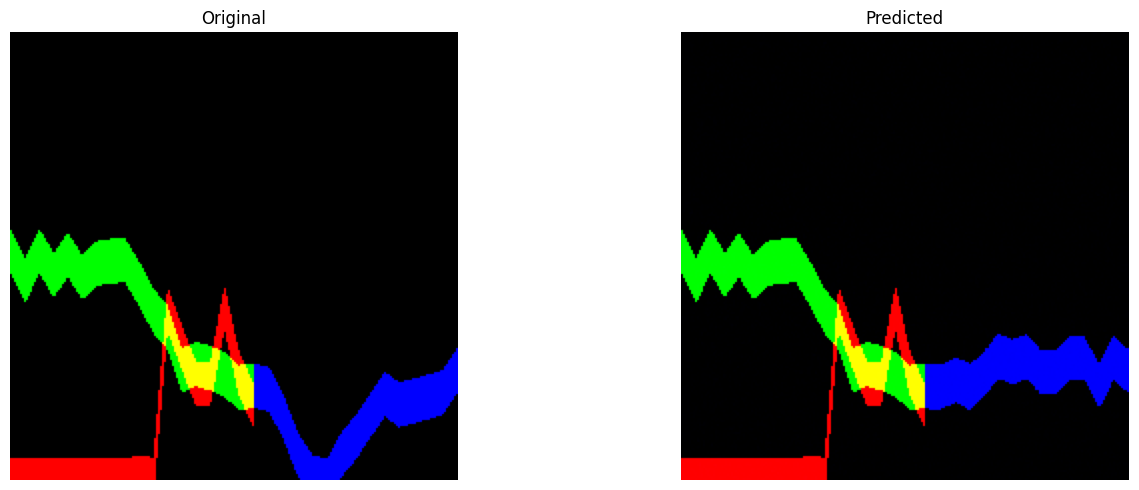
- Standard time-series forecasting models operate directly on numeric sequences. This asks a different question: can a stock's volume and price behavior be represented as an image instead, with each signal as a color channel — and can a diffusion model learn to fill in the missing channel, treating "predict the rest of the day's price movement" as conditional image generation rather than sequence forecasting.
- Approach
- Each trading day is encoded as an RGB image: red is trading volume, green is price movement before a cutoff time (the conditioning signal), blue is price movement after the cutoff (the signal the model has to generate). A conditional UNet — attention blocks, sinusoidal time embeddings, skip connections — is trained as a denoising diffusion implicit model (DDIM). Only the blue channel is noised during training; red and green stay fixed as conditioning input. At inference, DDIM sampling reconstructs the blue channel from pure noise, conditioned on the red/green channels of a held-out test day.
- Result
- Across the 9 evaluated test samples, the reconstructed post-cutoff (blue) channel reaches a mean squared error of ≈0.21 against the true channel (range ≈0.05–0.30 across samples) — the conditioning channels are reproduced exactly, as expected, and the generated channel lands closer-than-random but still noisy. Read as a proof-of-concept result, not a tuned forecasting benchmark.
ArtifactCode